Have you ever wondered what rubber settings the top players in Eleven Table Tennis use?
Discord user Korg put together an interesting analysis of the rubber settings used by the top 100 players on the 11 Clubhouse global leaderboard. That’s 200 rubber sides to look at, and there are some interesting patterns in the data.
I thought it was worth sharing a few of the findings here.
Oversized paddles are pretty popular

51 out of the top 100 players use an oversized paddle.
Players using oversized paddles also tend to use slightly lower bounce settings than those using standard-size paddles.
Does that mean oversized paddles are better? Not necessarily, but it’s interesting to see how common they are among highly rated players.
Defensive rubber is more common than you might think

26 players use a bounce setting below 0.60 on at least one side of their paddle.
Many of them use different setups on each side, combining slower rubber on one side with a more conventional setup on the other.
So if you’re experimenting with your own paddle, there’s no reason to assume both sides need to be identical. Different setups can serve different purposes.
Maximum friction is a popular choice
58 of the 100 players use maximum friction on at least one side.
On the other hand, 42 players use less than maximum friction on both sides. Clearly, maximum friction is popular, but it’s not a requirement for playing at a high level.
Bounce and throw tend to go together
One of the more interesting findings is that higher bounce settings tend to be associated with higher throw settings.
The relationship isn’t perfect, of course, but it’s worth keeping in mind when adjusting your own rubber. Changing one setting can affect how the overall setup feels, so it makes sense to experiment with bounce and throw together.
Is there a magic rubber setup for climbing the leaderboard?
Apparently, not an obvious one.
Korg’s analysis found little relationship between most rubber settings and Elo rating. Throw showed a weak negative correlation, meaning higher-rated players tended to use slightly lower throw settings on average.
That doesn’t mean the setting makes them better players. It simply shows that, among these top 100 players, there isn’t an obvious combination of rubber settings that separates the best from the rest.
And that’s probably the most interesting takeaway: there’s no single setup that everyone at the top uses.
Explore the data yourself
These are just a few highlights from Korg’s analysis. The full report lets you dig into the settings, compare the two sides of a paddle, and look for patterns across the leaderboard.
If you’re trying to find a setup that suits your own playing style, it could be a useful source of ideas.
Just remember that a setup that works for a top player won’t necessarily work for you. Use the data as a starting point for experimentation, not as a recipe you have to follow.
Big thanks to Korg for putting this together and sharing it with the community!
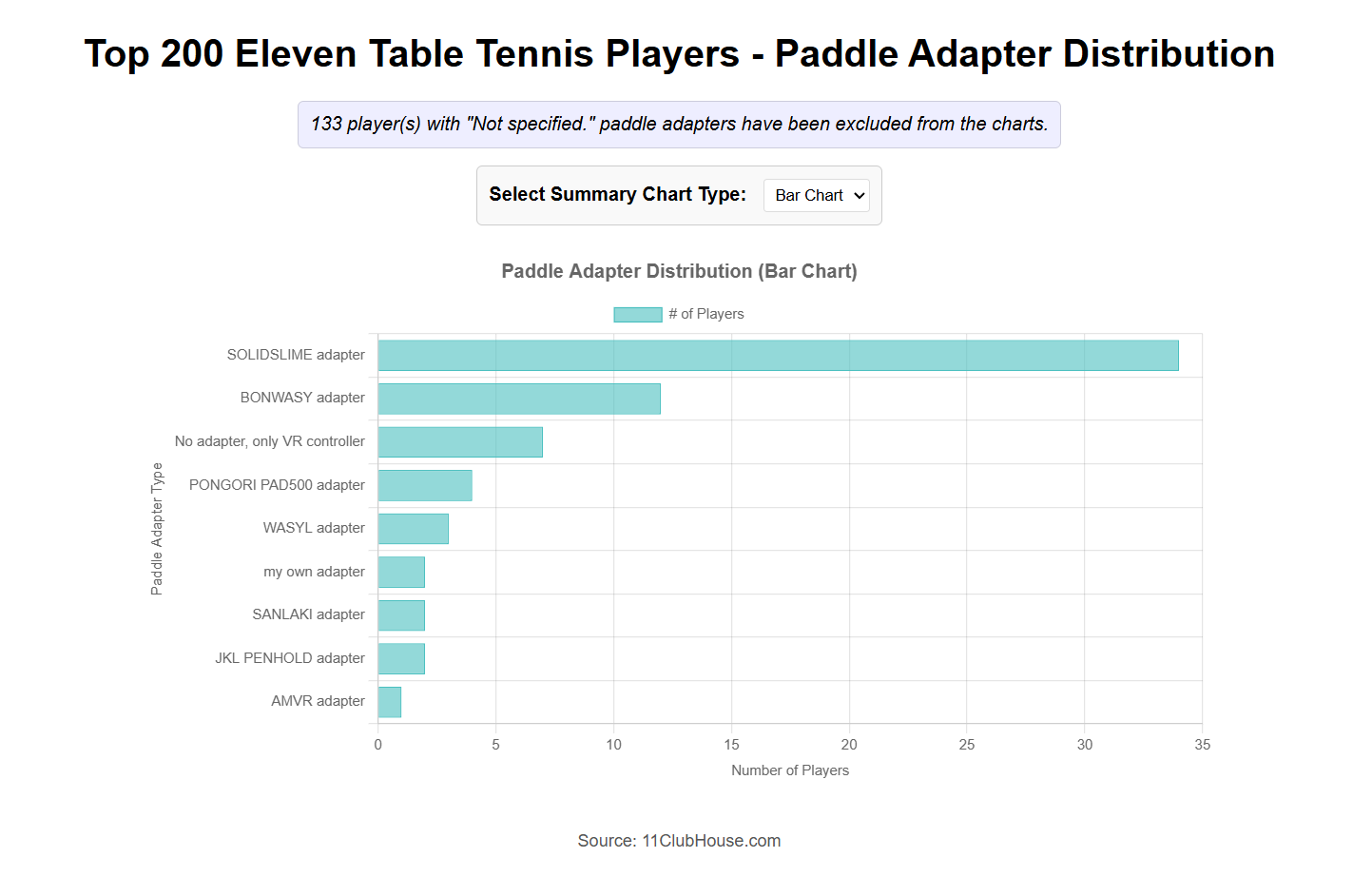
What adapters do the top players use?
Also, if you’re curious about which adapters top Eleven Table Tennis players use, here’s another graph based on data from 11clubhouse.
Among the players who use an adapter, most seem to be using SolidSlime. It’s really nice to see, and honestly, it means a lot to me. I’ve put a lot of time and care into these adapters, so knowing that players are finding them useful is both encouraging and motivating. A big thank-you to everyone who has chosen to use one and supported the project along the way!
