My friend bibchik has developed the amazing data mining website https://11tt.top/ .
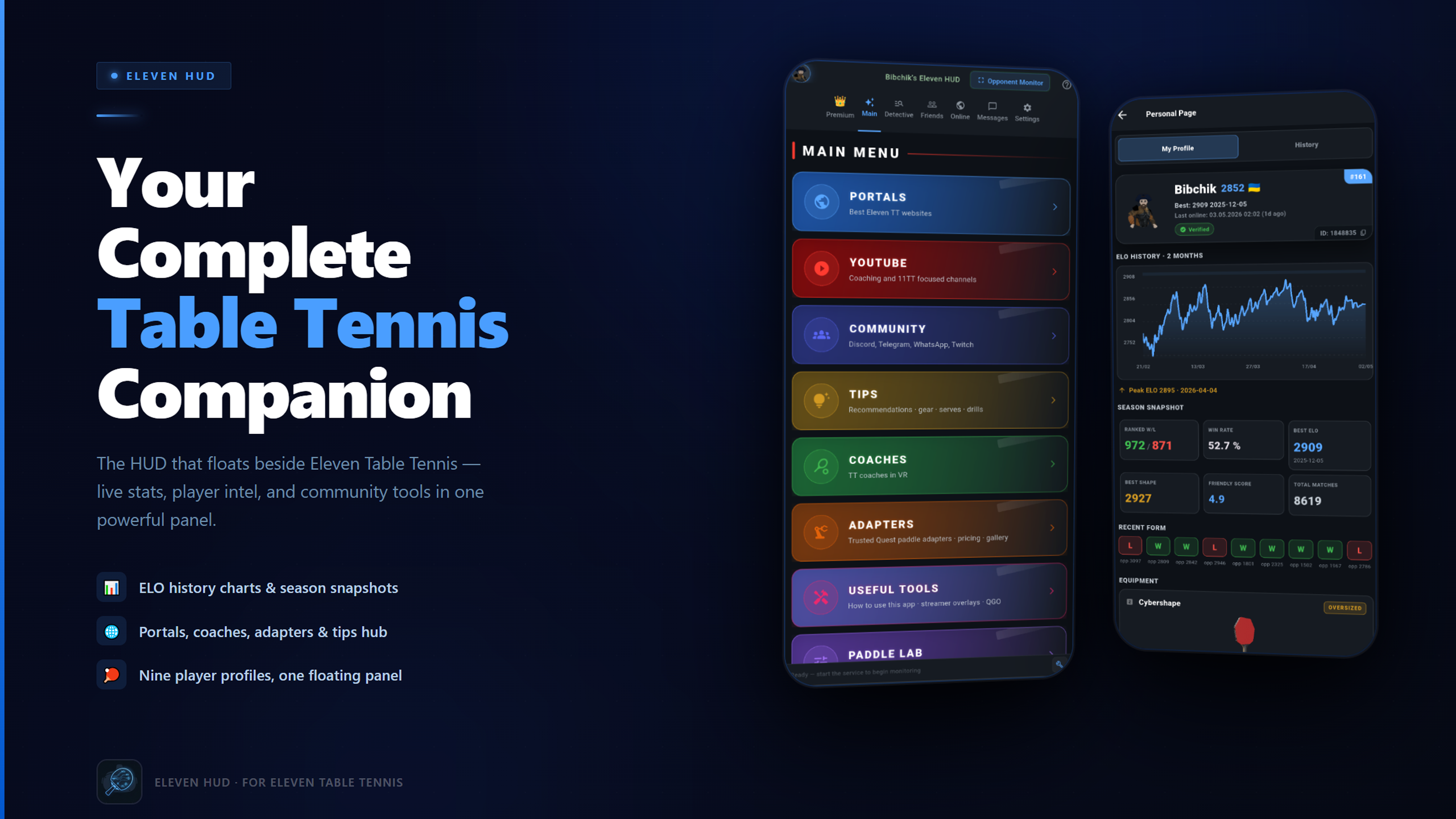
He also made a unique app called Eleven HUD that helps the players in various ways. Nobody describes it better than the creator:
I’ve been playing 11TT for a while and built something I always dreamed about but never found — a VR companion panel that floats beside the game. No headset off, no extra clicks.
Who it’s for:
📌 New to the game or VR? Real-player gear picks, paddle calibration, Ball Machine presets, and a curated starter guide — you won’t have to figure it out alone. 📊 Climbing the ladder? Best ELO, peak shape, recent results, win probability — even before accepting a match. Open Detective the night before a tournament and show up prepared. 💬 Social or casual? See who’s online, message friends, jump into group chats. Built-in community directory + 11Clubhouse friendly score at a glance. 🎯 Want good matches, not just ranks? Filter the global online list by ELO — a worthy opponent is two clicks away. 📚 Willing to improve? Curated coaching contacts, YouTube channels, and lesson series the community actually trusts.
Open Eleven HUD next to your game — and never play blind again.
Would love to hear what you think. I really hope you enjoy it as much as I do.
A huge thanks to every player who tested, gave feedback, and kept me going through the whole journey — and of course to carrotstein. You know who you are. 🙏
Premium unlocks extended analytics, Paddle Intelligence, AI Spy Analysis, Ball Machine Presets, faster opponent detection, and the full ELO-filtered online list.
Want to try Premium before committing? DM me — active community members might already spot a little surprise in their Premium tab 🙂
Have you ever wondered what rubber settings the top players in Eleven Table Tennis use?
Discord user Korg put together an interesting analysis of the rubber settings used by the top 100 players on the 11 Clubhouse global leaderboard. That’s 200 rubber sides to look at, and there are some interesting patterns in the data.
I thought it was worth sharing a few of the findings here.
51 out of the top 100 players use an oversized paddle.
Players using oversized paddles also tend to use slightly lower bounce settings than those using standard-size paddles.
Does that mean oversized paddles are better? Not necessarily, but it’s interesting to see how common they are among highly rated players.
Defensive rubber is more common than you might think
26 players use a bounce setting below 0.60 on at least one side of their paddle.
Many of them use different setups on each side, combining slower rubber on one side with a more conventional setup on the other.
So if you’re experimenting with your own paddle, there’s no reason to assume both sides need to be identical. Different setups can serve different purposes.
Maximum friction is a popular choice
58 of the 100 players use maximum friction on at least one side.
On the other hand, 42 players use less than maximum friction on both sides. Clearly, maximum friction is popular, but it’s not a requirement for playing at a high level.
Bounce and throw tend to go together
One of the more interesting findings is that higher bounce settings tend to be associated with higher throw settings.
The relationship isn’t perfect, of course, but it’s worth keeping in mind when adjusting your own rubber. Changing one setting can affect how the overall setup feels, so it makes sense to experiment with bounce and throw together.
Is there a magic rubber setup for climbing the leaderboard?
Apparently, not an obvious one.
Korg’s analysis found little relationship between most rubber settings and Elo rating. Throw showed a weak negative correlation, meaning higher-rated players tended to use slightly lower throw settings on average.
That doesn’t mean the setting makes them better players. It simply shows that, among these top 100 players, there isn’t an obvious combination of rubber settings that separates the best from the rest.
And that’s probably the most interesting takeaway: there’s no single setup that everyone at the top uses.
Explore the data yourself
These are just a few highlights from Korg’s analysis. The full report lets you dig into the settings, compare the two sides of a paddle, and look for patterns across the leaderboard.
If you’re trying to find a setup that suits your own playing style, it could be a useful source of ideas.
Just remember that a setup that works for a top player won’t necessarily work for you. Use the data as a starting point for experimentation, not as a recipe you have to follow.
Big thanks to Korg for putting this together and sharing it with the community!
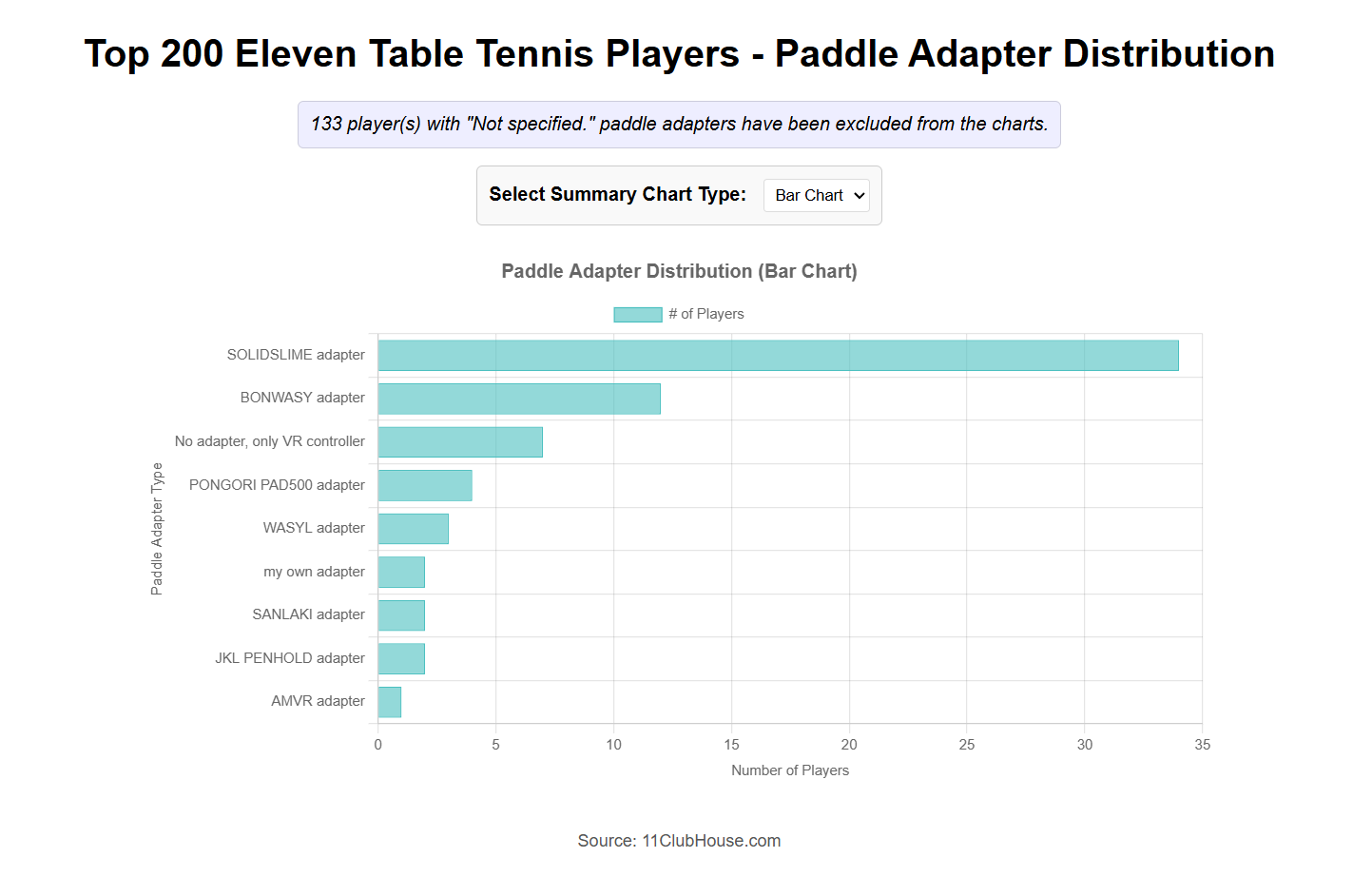
Also, if you’re curious about which adapters top Eleven Table Tennis players use, here’s another graph based on data from 11clubhouse.
Among the players who use an adapter, most seem to be using SolidSlime. It’s really nice to see, and honestly, it means a lot to me. I’ve put a lot of time and care into these adapters, so knowing that players are finding them useful is both encouraging and motivating. A big thank-you to everyone who has chosen to use one and supported the project along the way!
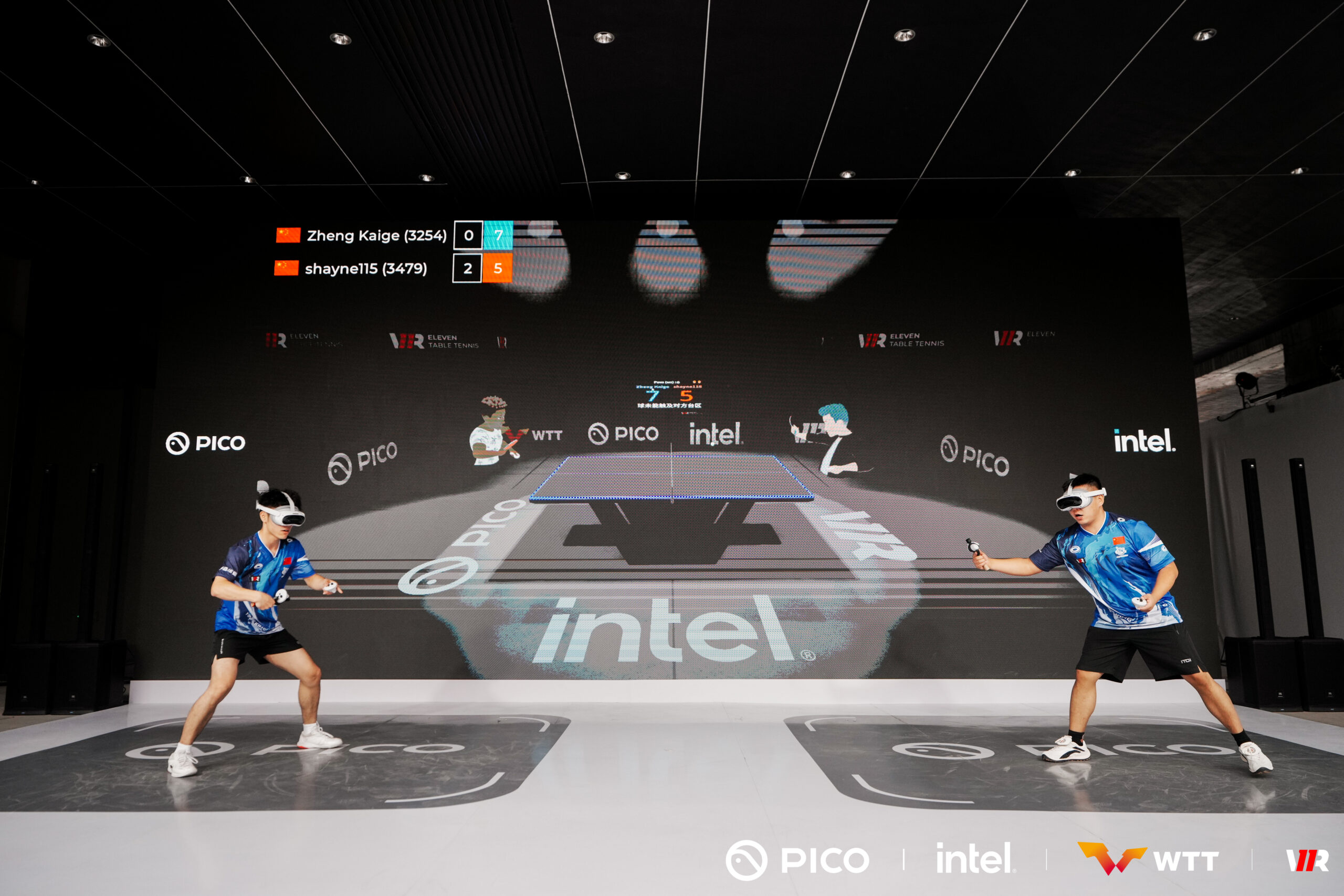
Today I got to watch the very first WTT E-Smash 2025 Tournament, and wow — what an event. Super well organized from start to finish. The venue’s actually the same spot where China Smash is happening, so there were tons of table tennis fans getting into the VR version of the game — a pretty cool crossover.
Since the event was co-hosted by Pico, all the players had to use the Pico 4 Ultra headset. Watching the finals, I was seriously impressed — the tracking on that thing is crazy good. It’s just a really solid headset overall.
Out of the eight players who made it to the final rounds, seven used the SolidSlime Pico 4 Ultra adapter (one is not using any adapters). Not a big surprise — these players all have amazing real-life table tennis skills, and a good adapter makes a huge difference when you’re trying to bring those skills into VR.
In the end, Shayne115, Forimba, and ZKGCurry took the top three spots.
Big congrats to everyone who competed!
I’ll do my best to train myself, so I will have a better chance of getting into the final next time 💪.
Below are a few photos from the event. I’ll spend the next few days to process the videos recorded.
Even though I love the multiplayer aspect of Eleven Table Tennis, from time to time I find myself looking for training tasks that can be done via single player. Recently I found a new VR table tennis game that fills this gap.
Introducing: Table Tennis Training Simulator, or T3S for abbreviation. In this article I will explain a few things that T3S offers.
Availability and Adapter Support
T3S is currently supported on both Pico and Meta Quest devices. It has position presets for almost all the SolidSlime adapters, as well as other good adapters like BonWasyl.
Physics
According to many players with ETT Elo above 3000, the physics of T3S is on par with Eleven VR. All the strokes feel very natural to execute.
Paddle Configuration
Most players would like to configure their paddle in order to make it suit their play style. The way to do that in T3S is very close to reality: you can select different options for blade (offensive/defensive…), rubber (tacky/non-tacky…), sponge (thickness and hardness…) individually via the UI. This makes it possible to configure the paddle based on the properties of the player’s real life racket.
In the official T3S discord server, there is a place where users are sharing their real life rackets and the in-game paddle configuration to match them.
Single Player Training Items
Since I was looking for single player training tasks, I have to mention that T3S provides 62 tasks, covering all the common TT techniques, serves and even has some for footwork training. All the tasks have very good human-recorded motion for both technique demo and the trainer. There are 186 stars to collect with an online leaderboard, which makes “grinding” the tasks a lot of fun.
You can practice against 48 different serves:
Below is a recording of me training against high spinny loop, which is a bane for a lot of players:
If you would like to play the shots to exact locations, the infinite target practice is a dream playground for that:
Other than the training tasks, there are numerous AI bots that can play in different styles (e.g. attack, defense, lob, different serves), all with human-recorded motion. One of the AI can even equip long pips!
Below is a recording of me practicing blocking against the “attack AI”:
Replay, Mirror Mode, Return Board etc.
These are all fantastic training features and they are all implemented with good quality in T3S.
You can record your serve motion, and then either view it at slower speed, or play it back so you can return your own serve.
You can play against yourself with either a delay or 0 delay (which makes it like juggling a ball, super fun).
You can play against a return board which is set at customized angle and distance.
Multiplayer
T3S now has a fully functional multiplayer mode (ping ball included), albeit with a smaller player pool at the moment. You can either play matches or do drills with other people.
The Ultimate Question: T3S or ETT?
To me who love table tennis asa sport and want to get the most value out of VR training, the answer is actually very simple: Both games help.
T3S excels at single player training. It makes training a fun experience, with progress that is easy to observe.
ETT has a huge online player base, ranked ladder and tournaments with cash prize.
The physics in both games are both very close to reality and close to each other. It still can take some time to get used to the difference between them, but it’s not that hard.
Thus currently I am using T3S to fix the known “short boards” in my techniques, and then switch to ETT to play against real person. This has been doing very well for me and a few other players who are doing the same.
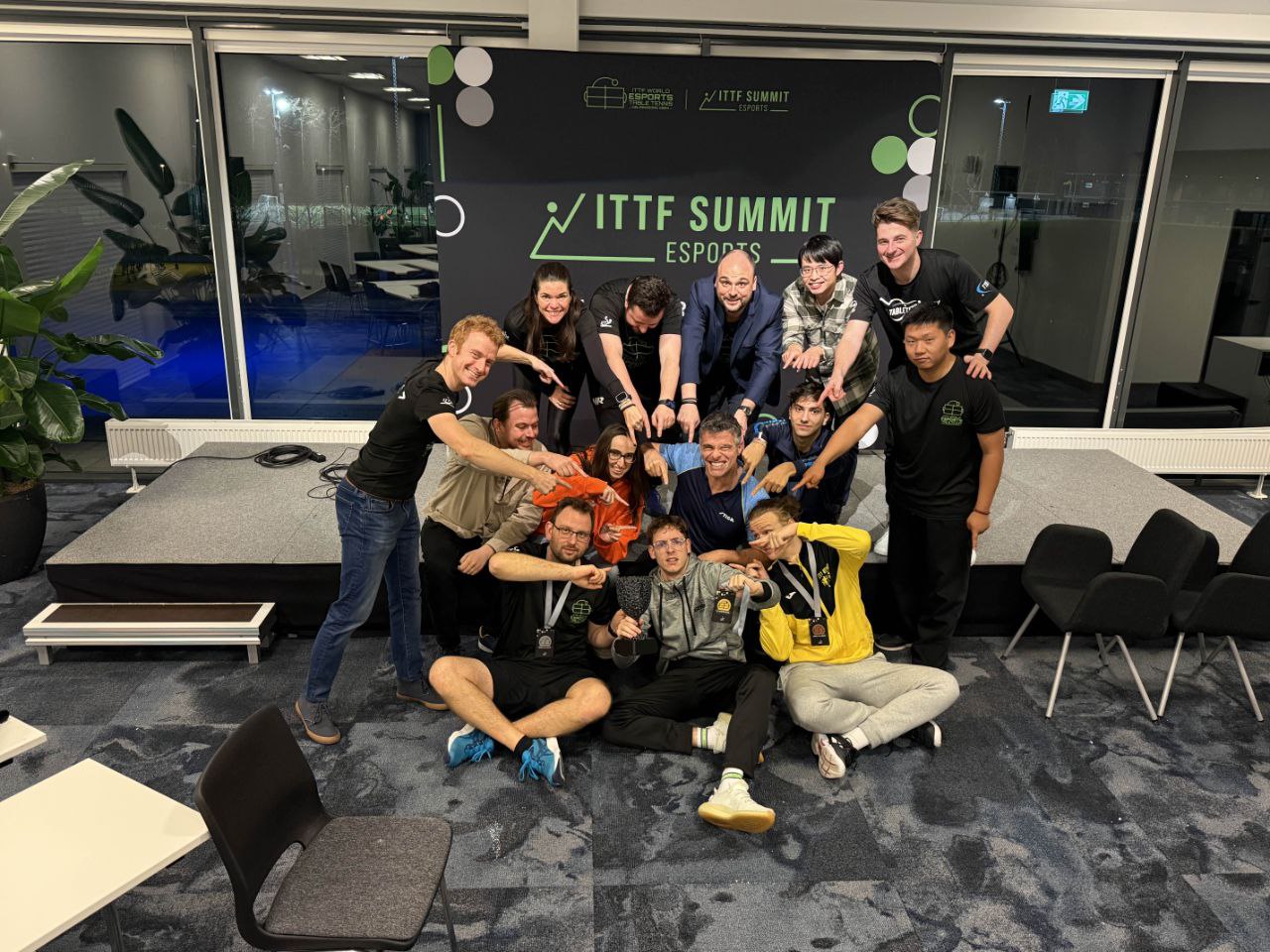
In November 24, 2024, I traveled to Helsingborg as a viewer of the ITTF eSports tournament 2024.
8 top players of Eleven Table Tennis fought valiantly and gave an amazing show to everyone. I was lucky to meet and chat with them all.
Congratulations to Anto, Aiphaton, and Swiss11Rally for winning the top 3 places! If you are wondering what equipment they are using: * Anto: Quest 2 + SolidSlime adapter * Aiphaton: Quest 3 + Bonwasy adapter * Swiss11Rally: Quest 3 + SolidSlime adapter
I also had the opportunity to meet the amazing people behind ETT, like carrotstien, Sulik, and Natasha. Dan from TableTennisDaily was also an important part of the event, as he was one of the commentators on site. We had a lovely chat about the game and the adapters.
There was also an ITTF eSports summit held at the same time. Officers and media from various countries were discussing how to push eSports table tennis forward.
I and excited to participate in this event, and I believe there will be more and more development in the future of VR table tennis!
I’ve made a highlight from the matches in day one:
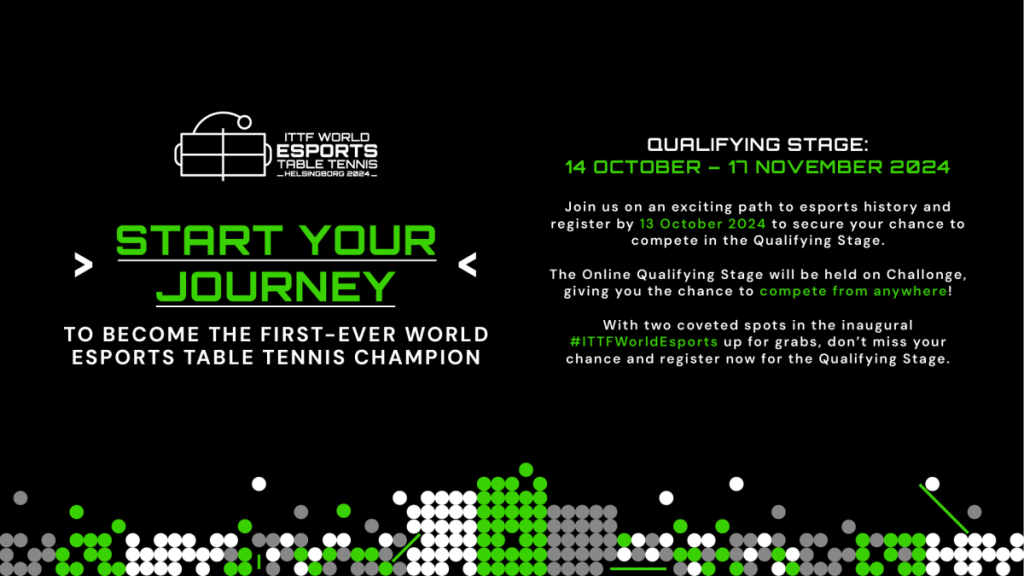
The ITTF World Esports Table Tennis Championships 2024 are here, and it’s your chance to become the first-ever Esports Table Tennis World Champion 🏆 Get ready to take your skills to the next level and make history with us this October and November 2024 with the launch of the inaugural ITTF World Esports Table Tennis Championships.
Building on the success of the Olympic Esports Week 2023, the ITTF is once again partnering with For Fun Labs, Inc. and their renowned VR game, Eleven Table Tennis.
This open, mixed-gender, and free-to-enter event will take place in two exciting phases: an inclusive qualification round designed to attract and engage players from around the world, followed by a thrilling final taking the center stage of Helsingborg Arena.
14 October – 17 November: Online Qualifying Stage
Players worldwide are invited to participate in the Online Qualifying Stage. The top two competitors will earn a place in the next stage of the competition. Register until 13 October here to start your journey towards becoming the first-ever ITTF World Esports Table Tennis Champion.
27-28 November: Finals in Helsingborg, Sweden The Helsingborg Arena will host the Finals, where eight elite players will compete for the prestigious title. The finalists will include the top two qualifiers from the Online Qualifying Stage, the two top-ranked Eleven Table Tennis players, one representative from the host country, and three wildcard entrants.
Gamers of the world, it’s time to hone your skills! Prepare for the qualifiers and stay tuned for more exciting updates 🏓
This website uses cookies to improve your experience while you navigate through the website. Out of these, the cookies that are categorized as necessary are stored on your browser as they are essential for the working of basic functionalities of the website. We also use third-party cookies that help us analyze and understand how you use this website. These cookies will be stored in your browser only with your consent. You also have the option to opt-out of these cookies. But opting out of some of these cookies may affect your browsing experience.
Necessary cookies are absolutely essential for the website to function properly. These cookies ensure basic functionalities and security features of the website, anonymously.
Cookie
Duration
Description
cookielawinfo-checkbox-analytics
11 months
This cookie is set by GDPR Cookie Consent plugin. The cookie is used to store the user consent for the cookies in the category "Analytics".
cookielawinfo-checkbox-functional
11 months
The cookie is set by GDPR cookie consent to record the user consent for the cookies in the category "Functional".
cookielawinfo-checkbox-necessary
11 months
This cookie is set by GDPR Cookie Consent plugin. The cookies is used to store the user consent for the cookies in the category "Necessary".
cookielawinfo-checkbox-others
11 months
This cookie is set by GDPR Cookie Consent plugin. The cookie is used to store the user consent for the cookies in the category "Other.
cookielawinfo-checkbox-performance
11 months
This cookie is set by GDPR Cookie Consent plugin. The cookie is used to store the user consent for the cookies in the category "Performance".
viewed_cookie_policy
11 months
The cookie is set by the GDPR Cookie Consent plugin and is used to store whether or not user has consented to the use of cookies. It does not store any personal data.
Functional cookies help to perform certain functionalities like sharing the content of the website on social media platforms, collect feedbacks, and other third-party features.
Performance cookies are used to understand and analyze the key performance indexes of the website which helps in delivering a better user experience for the visitors.
Analytical cookies are used to understand how visitors interact with the website. These cookies help provide information on metrics the number of visitors, bounce rate, traffic source, etc.
Advertisement cookies are used to provide visitors with relevant ads and marketing campaigns. These cookies track visitors across websites and collect information to provide customized ads.